Gangnam's Express Bus Terminal Is a Transit Hub Pretending to Be a Shopping Mall — Or Maybe the Other Way Around
How to catch a bus at Seoul Express Bus Terminal in Gangnam: which building, which gate, what to eat while you wait, and why Daiso and Shinsegae sit under the same roof.
2026-07-13 · 9 min read
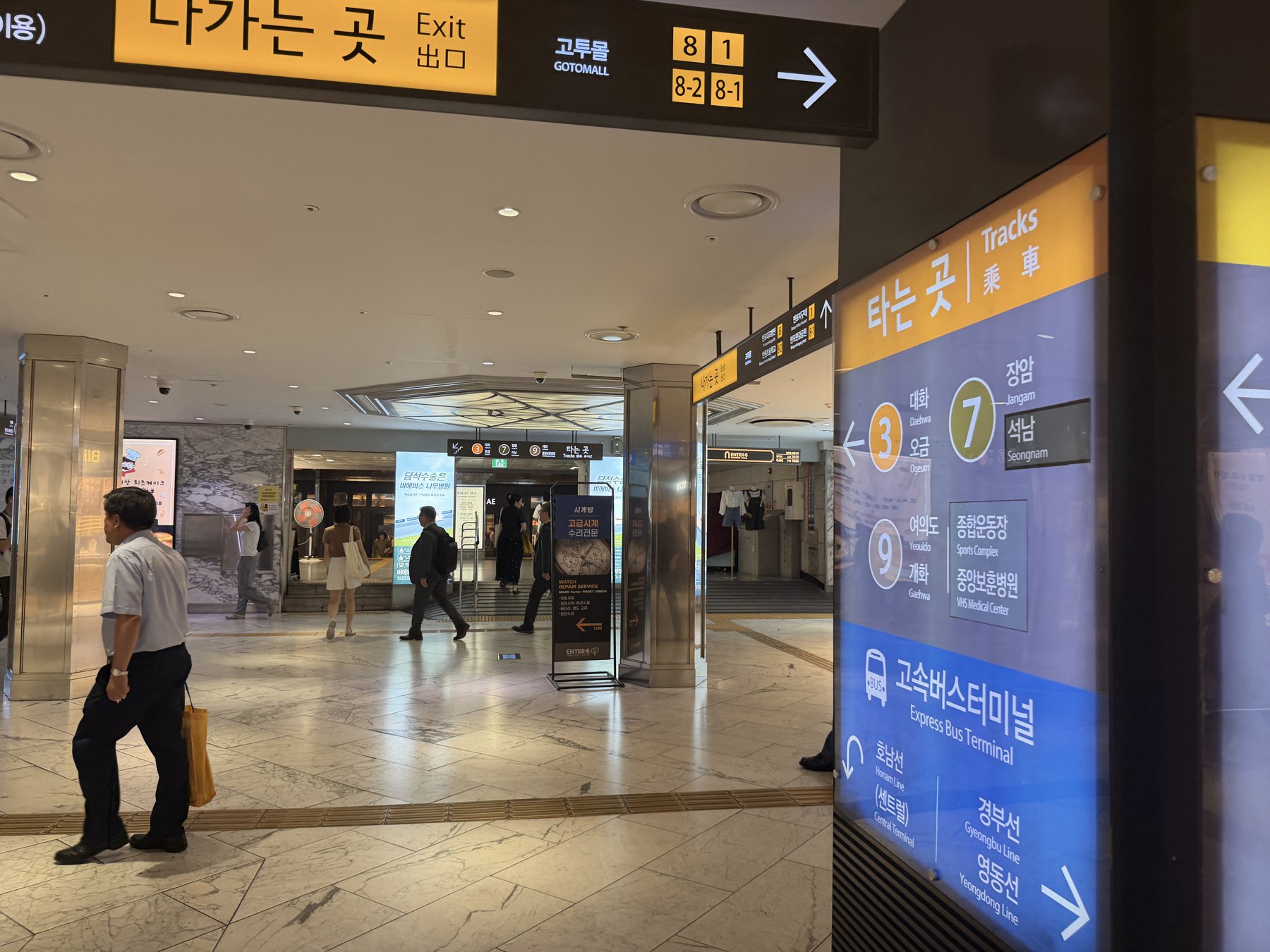
People call the whole area "Gangnam terminal." The signs disagree in three fonts — and somehow you still need all of them.
The first time I tried to catch a bus at Gangnam Express Bus Terminal, I followed three different signs for three different buildings and still ended up buying socks. That should have told me everything.
The first time I tried to leave Seoul by express bus from Gangnam, I thought I was going to a bus station. What I walked into was closer to a weather system: arrivals, departures, department-store perfume, fried food, suitcase wheels, and an underground shopping street that refused to end.
Locals shorthand the whole complex as 고속터미널 — Express Bus Terminal — even though the area is really two neighboring giants sharing one subway station. On one side sits Seoul Express Bus Terminal, the long-distance gateway for Gyeongbu and Yeongdong routes (think Busan, Daegu, Gangneung and a long list of elsewhere). Next to it is Central City, the Honam-line hub (Gwangju, Jeonju, Mokpo, and friends). If you get the building wrong, you do not get a charming adventure. You get a jog with a suitcase.
I learned this the hard way while staring at a departure board and realizing my bus was in the other building. Where I'm from, a bus station is usually one shed with bad coffee. Here, missing your gate can mean crossing into an entirely different commercial ecosystem.
How You Actually Catch the Bus
The practical version, after a year of not wanting to learn this again:
Book ahead on KOBUS (kobus.co.kr) or the Tmoney GO app when you can. Weekends and holidays sell out in a way that makes "I'll just buy it there" feel optimistic. Mobile tickets usually mean a QR code — no paper romance required. If you need a counter or kiosk ticket, those exist too, but the line will teach you patience.
Arrive early enough to do the one thing every sign is trying to tell you: confirm which terminal, which floor logic, and which boarding gate. The screens matter. Matching your destination to the correct half of the complex matters more. Gyeongbu/Yeongdong versus Honam is not trivia. It is the difference between being early and being a person power-walking past Dunkin' with a rolling bag.
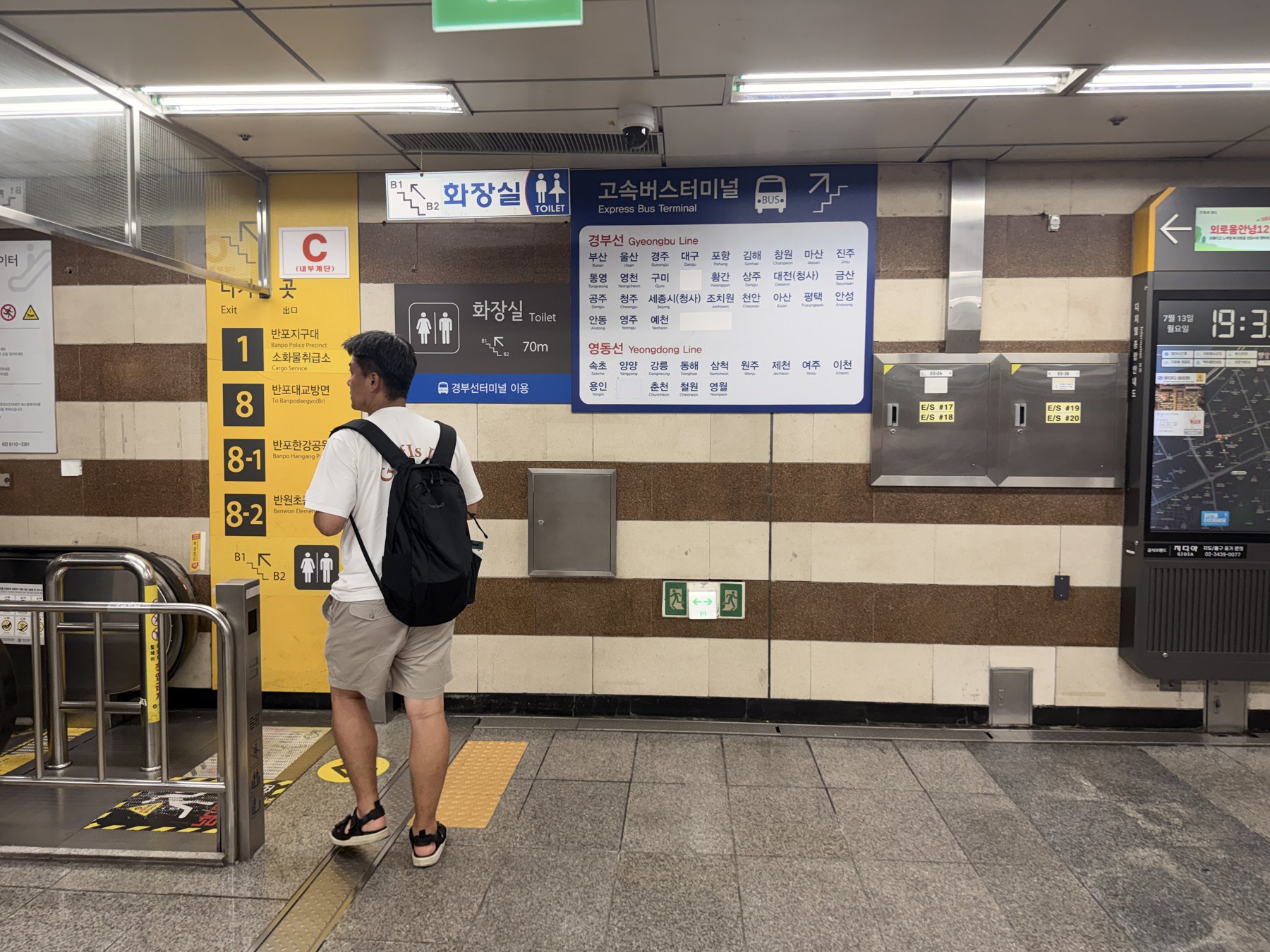
The whole trip hinges on one boring detail: the right building, the right line, the right gate.
And even once you think you've memorized your 승차홈 — the boarding platform number printed on your ticket — the terminal can still move it on you. I once headed for platform 32 the way I always do, then stood there blinking while the world had quietly relocated that bus to 36. Brief panic. Not catastrophic, just the particular shame of looking confident in the wrong place.
What makes it different from an airport is the silence around the change. There's no loud gate-swap announcement rolling through the ceiling. You find out because a freestanding board says so — 승차홈 위치 변경 안내 — construction moved platforms 31 through 36, red arrow, 이쪽으로 이동해주세요. Miss the sign, miss the bus.
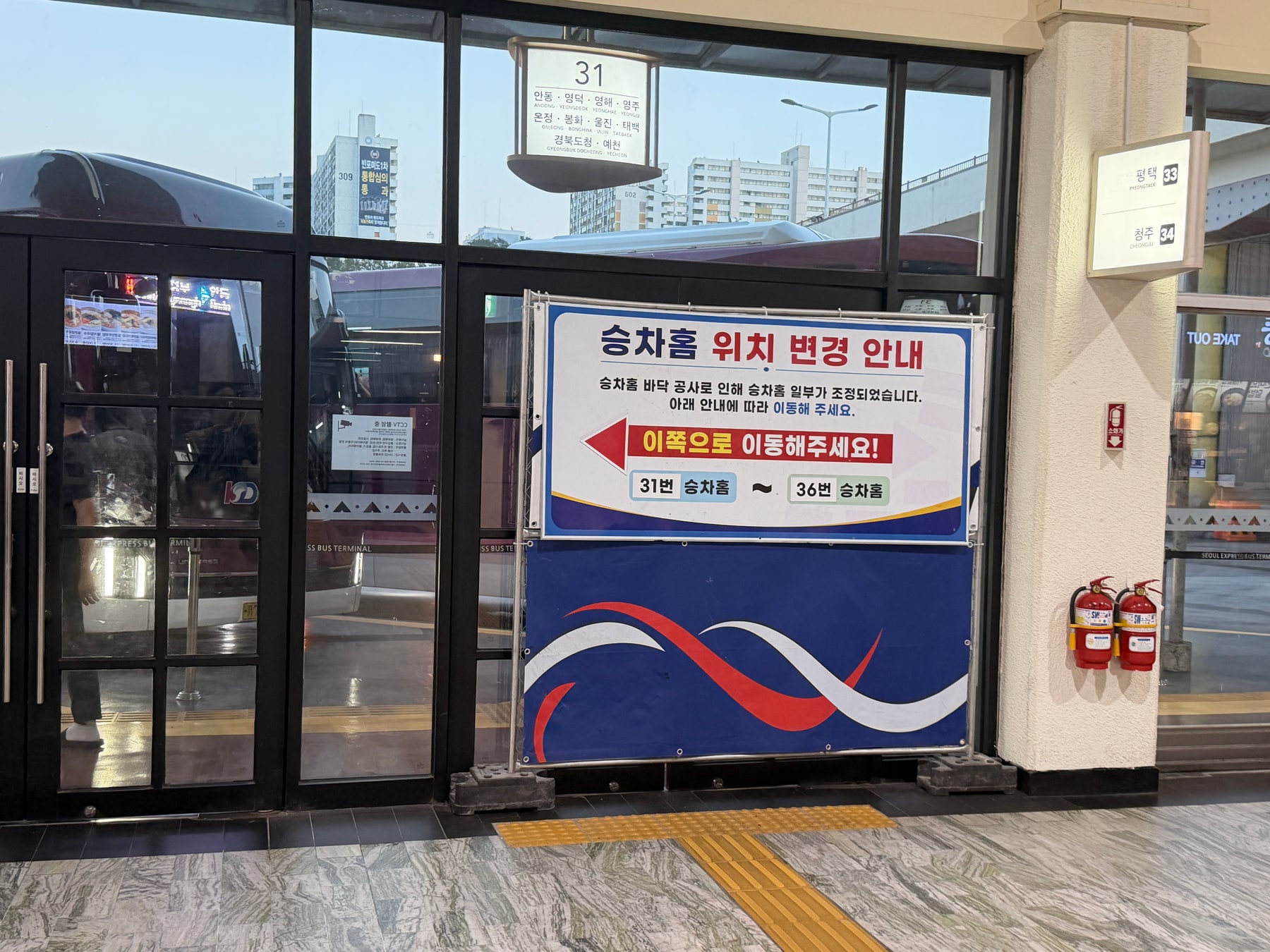
Not an airport PA. A temporary board between the gates. Read it, or stand at the wrong door.
Luggage culture here is practical. Coin lockers and baggage storage exist for a reason — because people treat the terminal as a pause button, not just a launch pad. If your bus is in two hours, the building assumes you might disappear into shopping and come back smelling faintly of cosmetics samples.
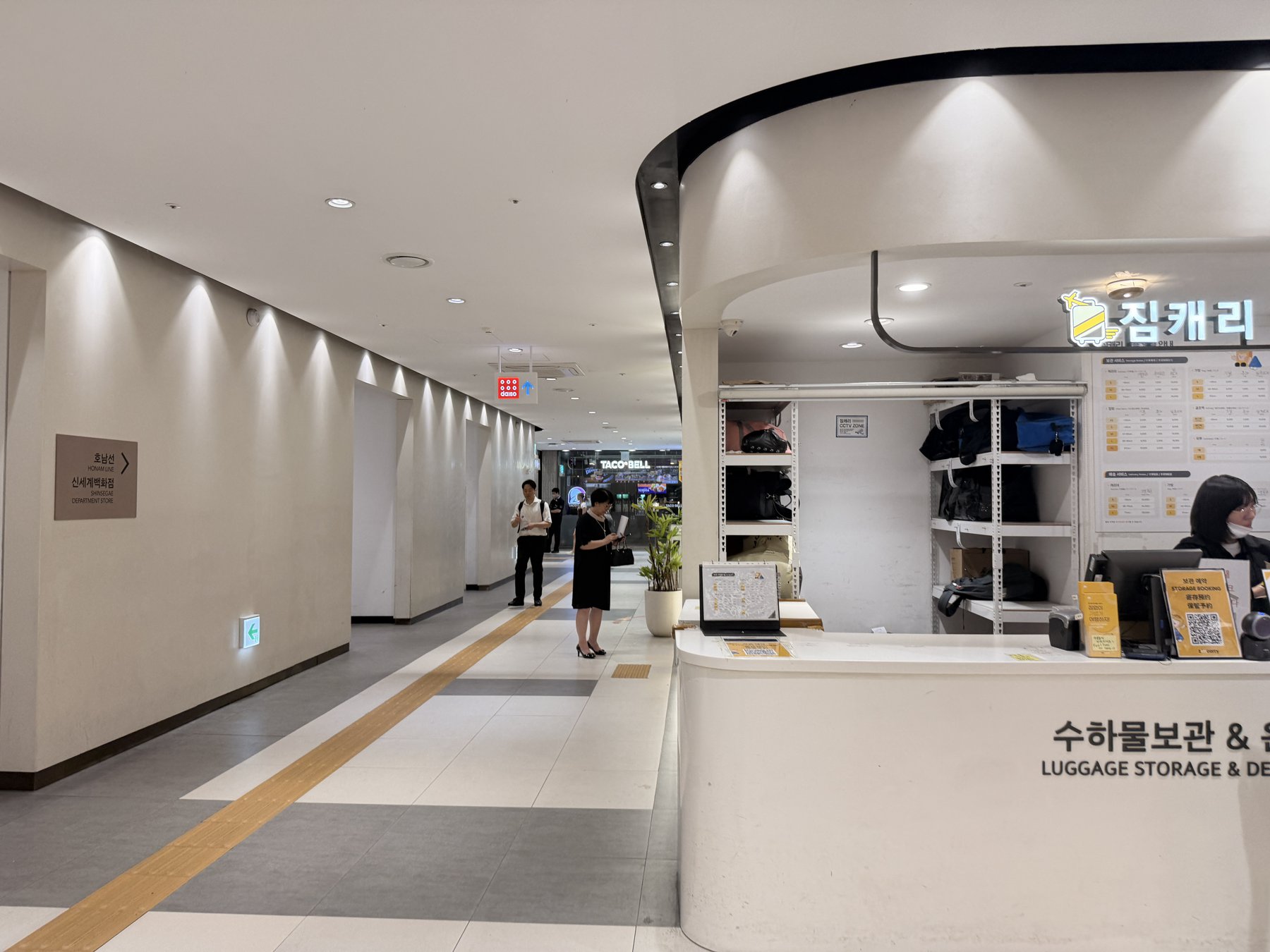
A suitcase on pause — the building expects you to wander.
Once you're actually on the bus, there are usually two men doing the quiet work of departure. One is the driver. The other is the guy whose job seems to be checking that everyone is in the seat their ticket sold them — not wandering, not doubling up, not staking out the wrong window. Assigned seating is part of the system, and he treats it that way.
The part that always makes me smile starts about two or three minutes before departure. Those two stand near the door and do a short, practical huddle: is anyone still running? Anyone delayed? Anyone we should wait half a beat for? It's not theatrical. It's two adults scanning the platform for a late suitcase, then nodding that the bus is full enough to go. Once you notice that exchange, you listen for it every time.
I still flinch a little every time I see how casually Koreans navigate this place with one hand on a coffee and the other on a suitcase handle. It took me longer. The terminal does not care about your learning curve. It just keeps moving people through.
Waiting Is a Food Court with Timetables
If you only experience express bus terminals as sad plastic chairs, Gangnam will confuse you. The waiting ecosystem is thick with convenience stores, bakeries, chain cafés, kimbap counters, noodle spots, and the kind of restaurants that understand travelers have twenty-five minutes and complicated emotions.
I have eaten more "just something hot before Busan" meals here than I want to admit. Not destination dining. Transitional dining. Food designed for people who might hear their gate called mid-bite.
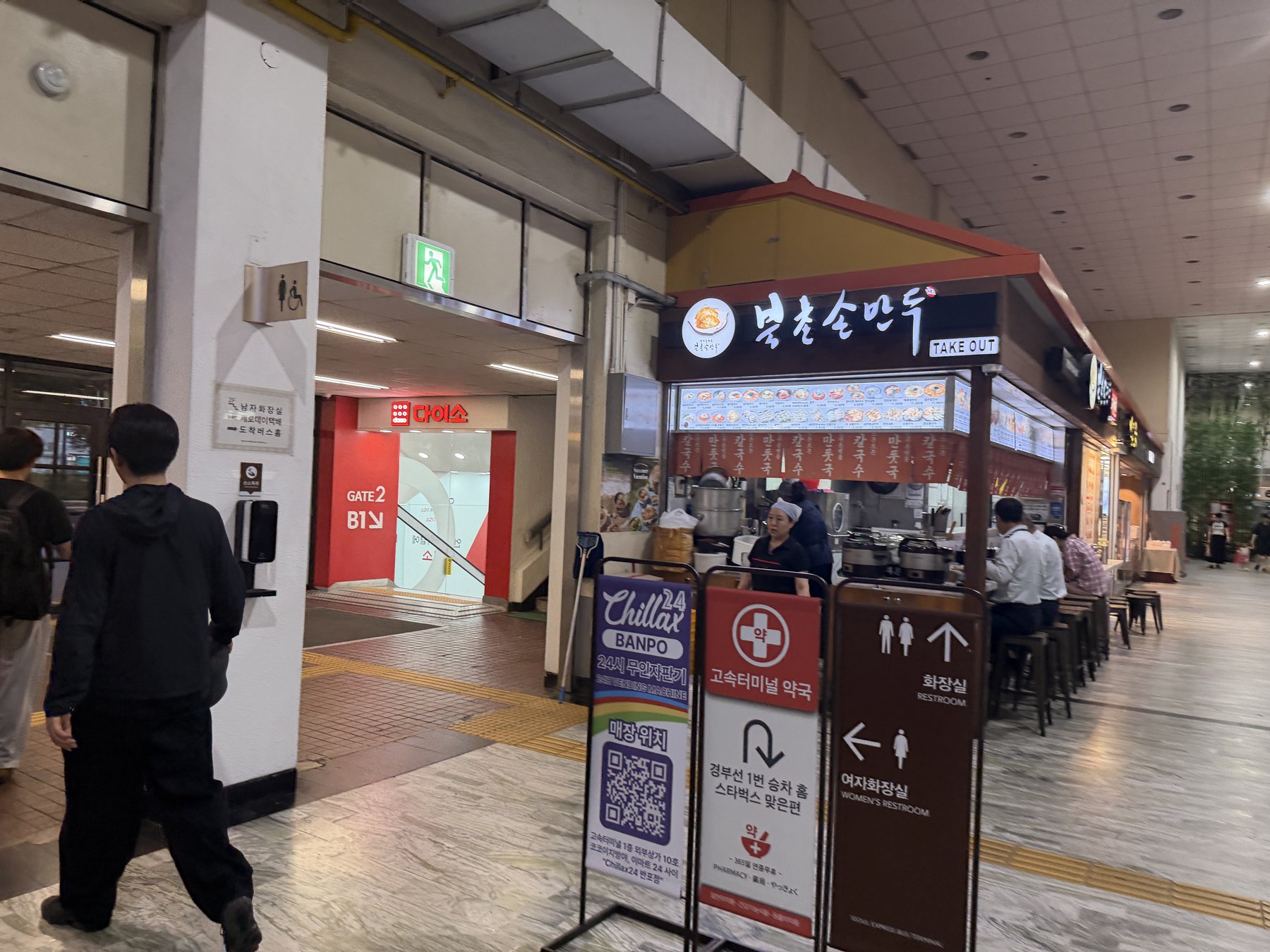
Meals timed to departure boards — and a Daiso arrow if your stomach finishes early.
The mood is not glamorous. It is useful. And usefulness, in a dense city, is its own kind of hospitality.
The Subway Underneath Is Half the Point
Under all of this sits Express Bus Terminal Station — 고속터미널역 — where Seoul Metro Lines 3, 7, and 9 meet. That triple transfer alone would make the place important. Connected to the terminals and shopping layers, it becomes something stranger: a vertical city where you can arrive by train, buy socks, escalate into a department store, and leave by highway bus without ever feeling fully outdoors.
The transfers are long enough that locals warn you about them, especially involving Line 9. Follow ceiling signs like your life depends on them. Mine did, emotionally, the day I almost boarded the wrong direction after twenty minutes of confident wrong walking.
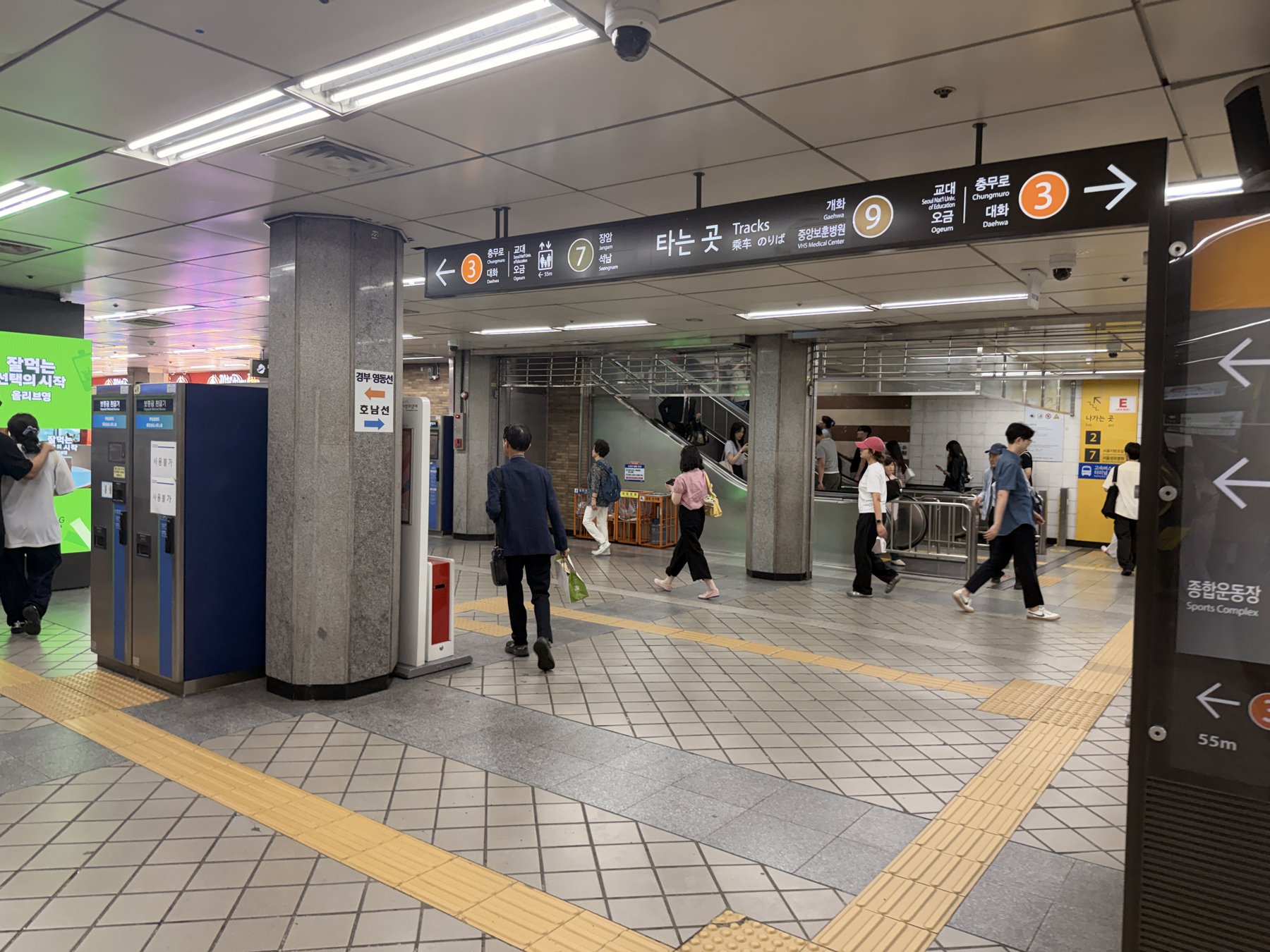
Lines 3, 7, and 9 under one name — and a workout between platforms.
Exits toward 8 / 8-1 / 8-2 are the ones shoppers memorize, because they spill you toward underground shops and Shinsegae connections. If the bus terminal is the machine that sends people out of Seoul, the station is the machine that keeps feeding that machine.
Daiso, Shinsegae, and the High-Low Whiplash
One of my favorite Seoul contrasts lives here in one vertical stack. On the express terminal's basement level sits a notably large Daiso — the kind of store where you go in for a phone cable and exit with organizers, snacks, and a sense that capitalism winked at you. Bloggers and locals talk about how big the Gangnam Express Bus Terminal Daiso is for a reason. It is not a cute corner shop. It is a supply depot for people about to sit on a bus for four hours.
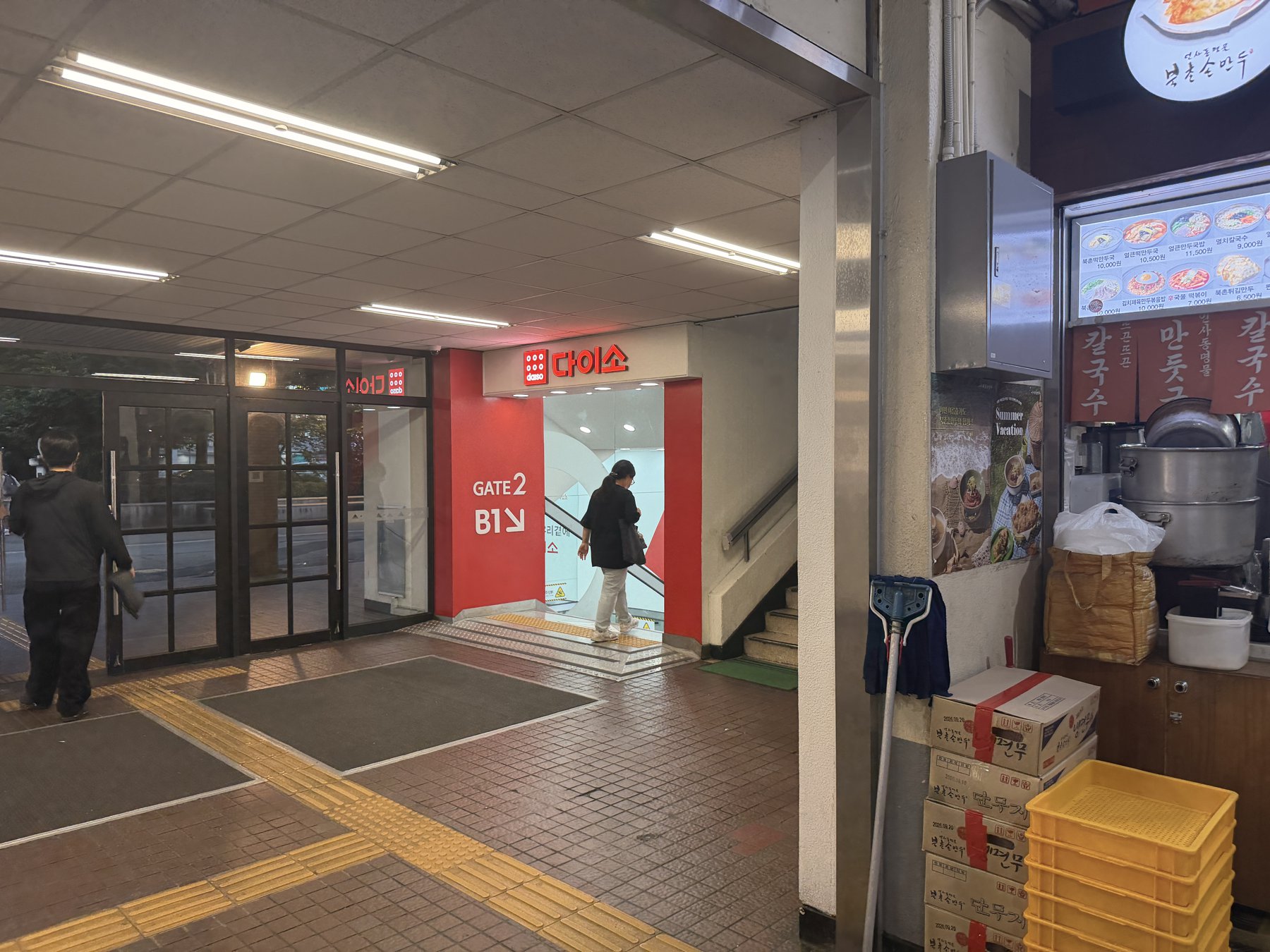
GATE 2, B1 — the descent into phone cables, trays, and impulse snacks.
Then, without enough emotional preparation, the corridors can lead you toward Shinsegae Gangnam — polished floors, perfume air, the whole department-store posture. Central City and Shinsegae's presence in this hub is part of why the area feels less like "bus station" and more like "city with buses attached."
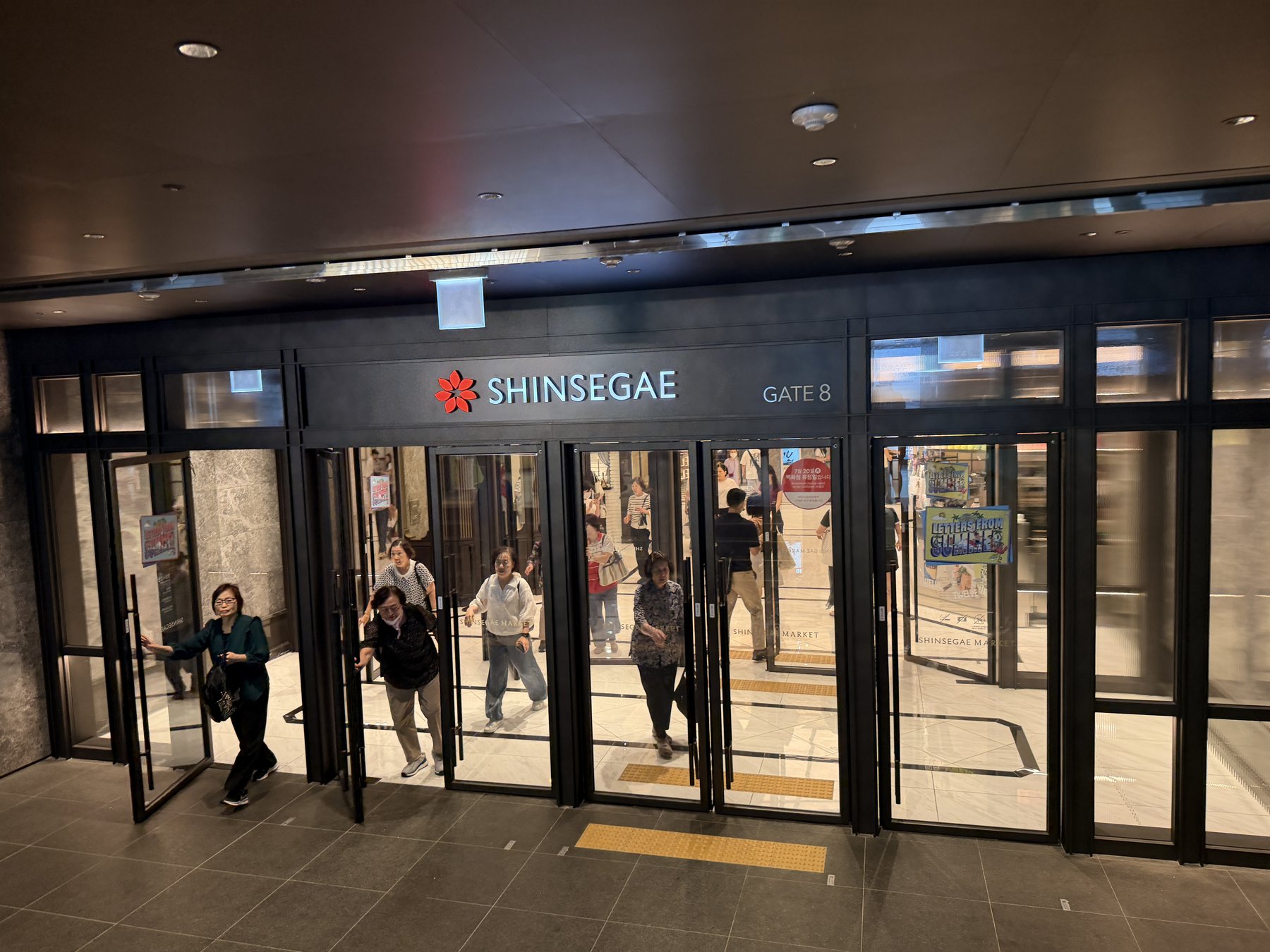
Same afternoon: ₩1,000 trays downstairs, department-store glass upstairs.
That high-low whiplash is very Seoul. One minute you are comparing plastic containers. The next you are walking past a luxury window display while still holding a bus QR code.
What Changed My Mind About the Express Bus
It's not a flawless ride, to be clear. My one real complaint about the buses themselves is that the windows don't open. I tell myself there's ventilation running somewhere, for my own peace of mind, but in the thick of summer or the depths of winter, when the heating or air conditioning is cranked all the way up, I start to suspect the vents aren't really doing much of anything. It's a small, sealed-in kind of discomfort that no amount of terminal shopping fixes.
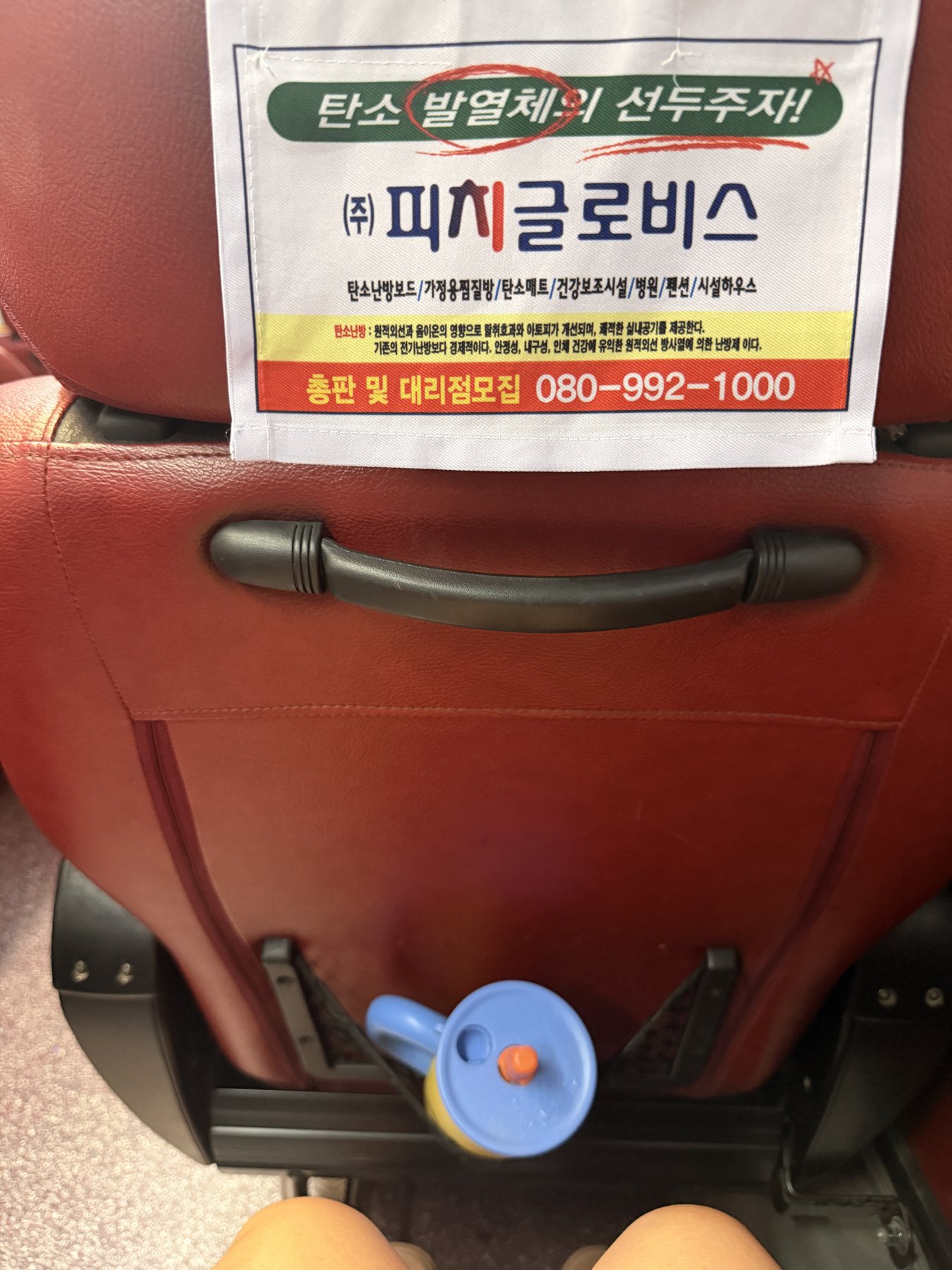
Sealed in for the highway stretch — coffee stays, windows don't open.
And still, I keep taking them. Korea's long-distance bus culture matters even in an era of KTX and flights — you sit down in Gangnam and wake up somewhere else without negotiating an airport. The sealed cabin is the price of that particular kind of convenience. I flinch at the stuffiness, then I book the next one anyway.
And Still, the Terminal
The building around those buses is a different story. At first I found Express Bus Terminal overwhelming — too many buildings, too many signs, too many ways to be slightly wrong. Somewhere along the way that flipped. Now I treat it as one of Seoul's most honest public rooms: a place designed for people in transition, which means it has to feed them, sell them chargers, move them between train and highway, and tolerate their confusion.
It is annoying to navigate. It is efficient once you learn the grammar. It is, in its overbuilt way, kind of a fascinating place to kill two hours.
I still check the wrong screen first sometimes. But I've also started listening for my destination the way you'd listen for a gate call in an airport — except here the soundtrack includes suitcase wheels, fried food, and a distant Daiso announcement about a clearance aisle.
If you come, give yourself more time than the timetable suggests. The building will try to turn you into a shopper before it turns you into a passenger. That is not a bug. That is the terminal.
Location note: Seoul Express Bus Terminal / Central City area, Seocho-gu (Banpo) — Express Bus Terminal Station on Lines 3, 7, and 9. Busy working hub; be mindful of travelers with luggage.