My Apartment Complex Has an Unmanned Ice Cream Shop That's Open 24/7 — And the Rules Inside Are Funnier Than They Sound
There is no cashier, no clock-out time, and, apparently, no loitering. Inside a glass box the size of a small living room, Korea's dessert moment is stacked in freezers — waiting for someone to swipe a card and leave.
2026-07-16 · 6 min read
There is no cashier, no clock-out time, and, apparently, no loitering. Inside a glass box the size of a small living room, Korea's entire dessert moment is stacked in freezers, waiting for someone to swipe a card and leave.
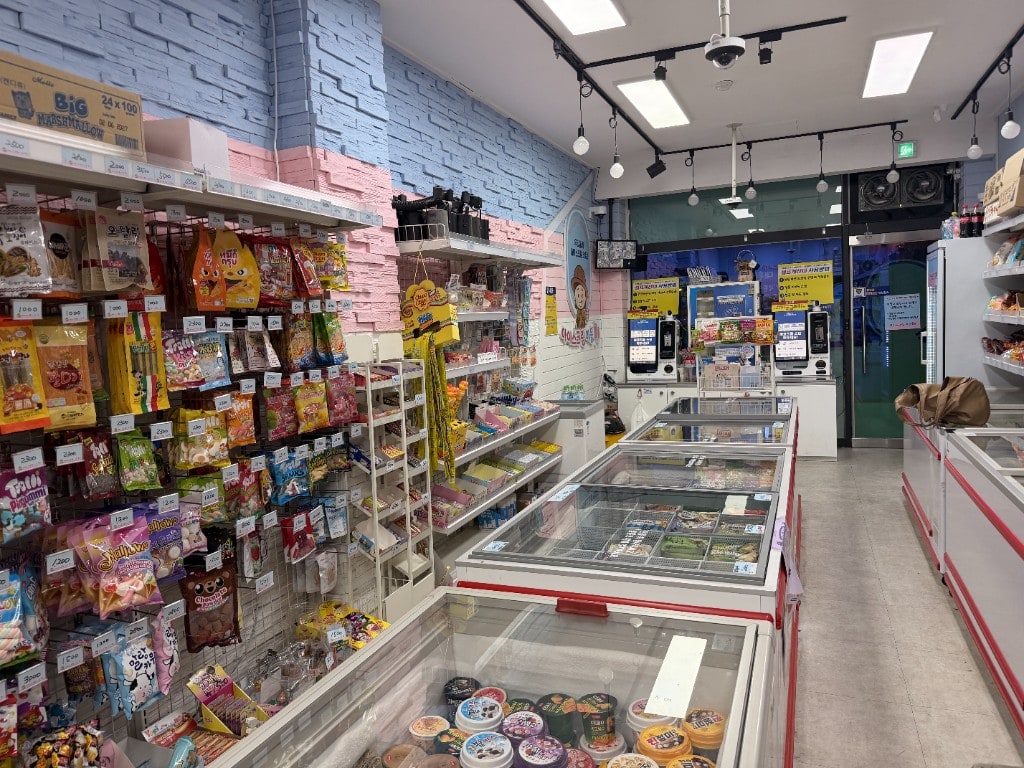
Chest freezers down the middle, snack wall on the left, two kiosks at the back — the whole shop runs without a single staff member.
I walk past it almost every day and I still haven't gotten used to the idea that it's simply always on. Not "open until 11." Not "closed Sundays." Always. 365 days a year, inside my own apartment complex, there is a small unattended room full of ice cream that never locks its door.
And this isn't a quirky one-off in my neighborhood. These unmanned ice cream shops — 무인아이스크림점 — have spread through ordinary Korean apartment complexes and side streets so thoroughly that they've become almost background. Labor costs keep climbing; a freezer room that doesn't need a night shift still somehow pencils out.
A Freezer Full of Korea's Current Obsessions
What actually stopped me from just walking past it, camera-first, was the freezer contents. This isn't a 7-Eleven cooler with the same five bars it's had since 2015. It's a rotating snapshot of whatever Korea is currently deciding a dessert should be.
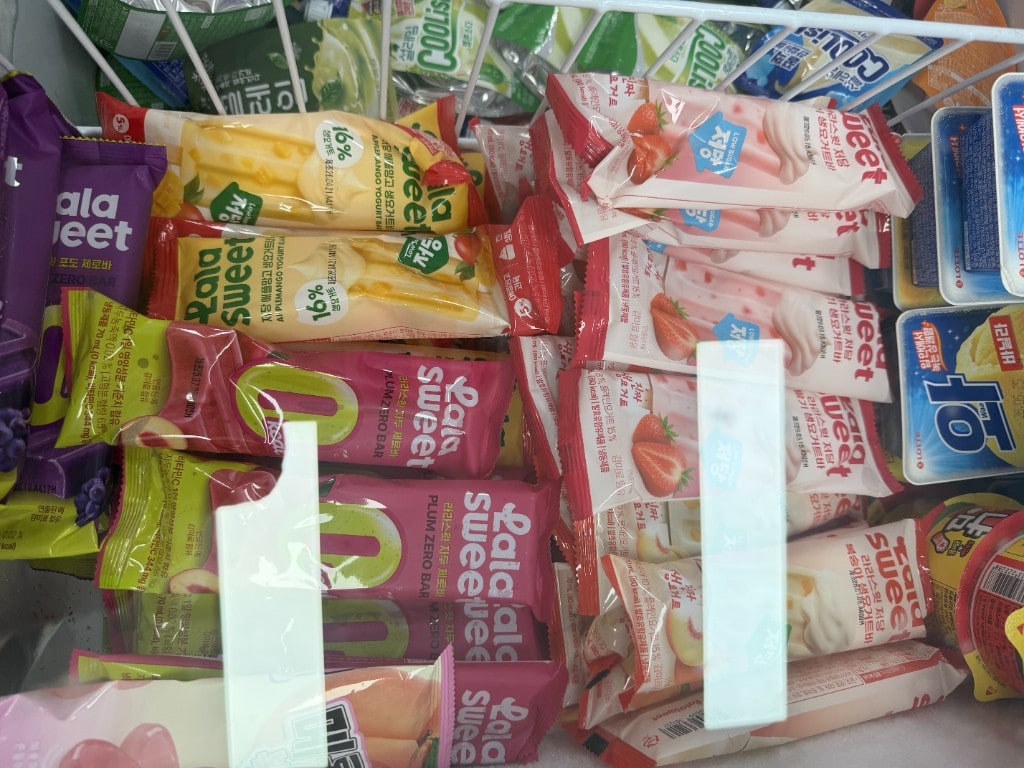
"저당" and "제로" stamped on half the wrappers — Lalasweet basically owning this corner of the freezer.
Half the shelf is labeled 저당, low-sugar, marketed as plainly as the flavor itself — proof that "guilt-free" stopped being a niche health-food pitch here and became a mainstream selling point. Lalasweet (라라스윗) is the brand that shows up again and again in that lane. It's the low-sugar ice cream that actually sells, and I keep buying it because the ingredients list reads cleaner than most freezer candy pretending to be dessert.
Next to it, protein ice cream — the kind that lists grams of protein on the front of the package like a supplement, not a dessert.
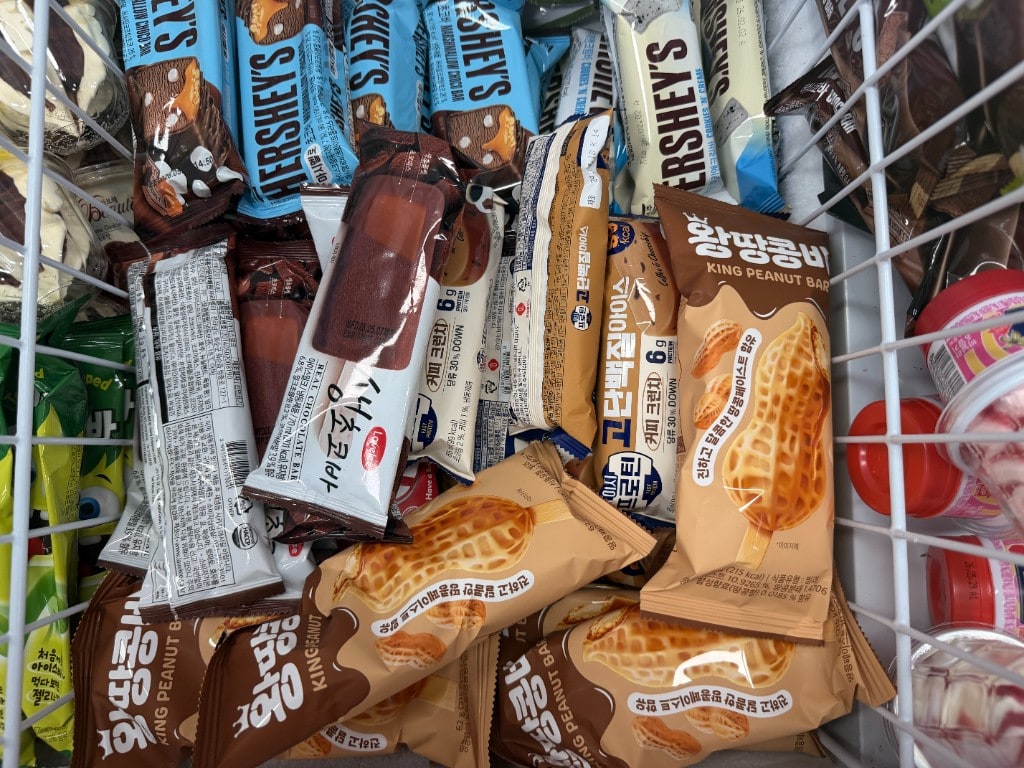
6g protein, sugar 30% down — dessert packaging that talks like a nutrition label.
And then there's the one that made me stop and smile: a zero-sugar Screw Bar (스크류바 제로). The original Screw Bar has been a Korean summer object for decades — that twisted pink popsicle kids ate thirty years ago is somehow still here. Only now it comes in a 저당 / zero version, because even nostalgia has to make room for the current obsession with sugar counts.
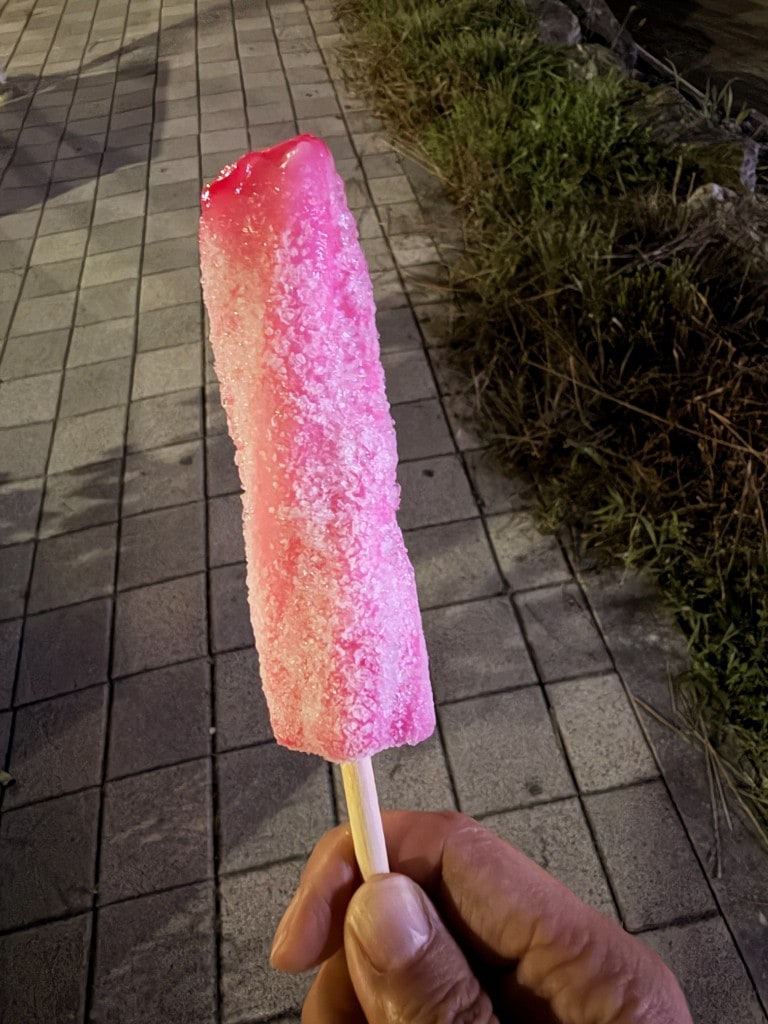
I did eventually leave with one. Zero-sugar Screw Bar, eaten on the sidewalk like the sign wanted.
Low-sugar for the people counting, protein for the people lifting, classic candy reincarnated as its own diet edition. One freezer, several completely different reasons to buy ice cream, none of which require staff.
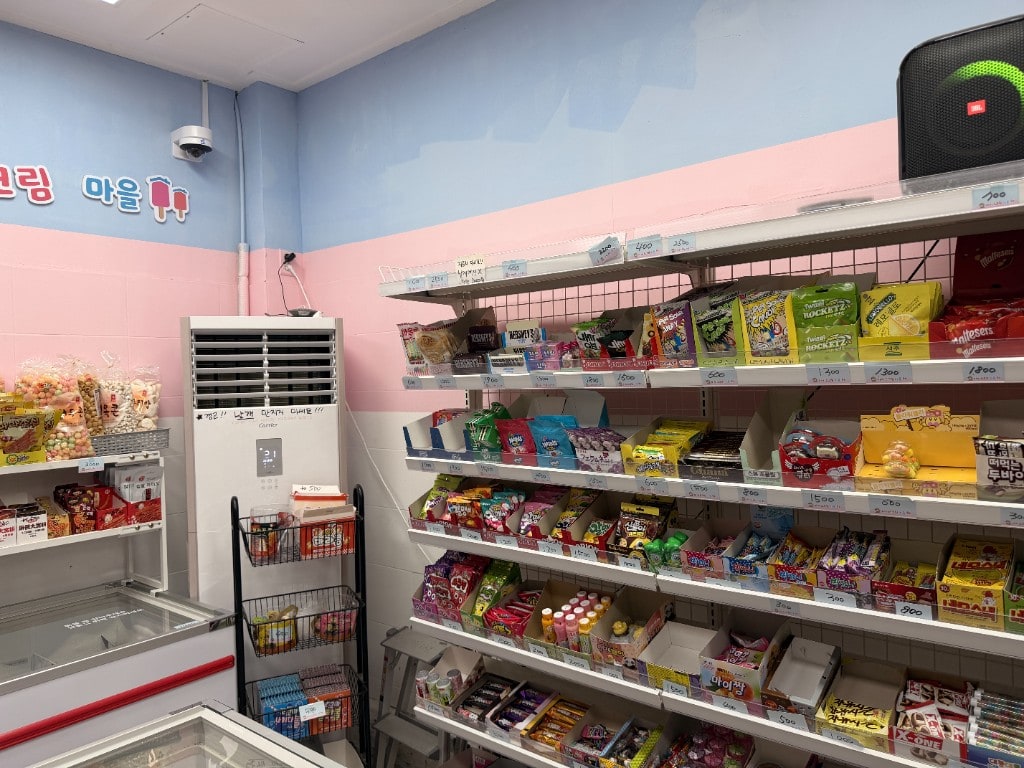
Not only ice cream — the snack wall is a secondary reason to swipe a card at midnight.
The Sign on the Wall That Undercuts the Whole Concept
And then there's the part that actually made me laugh out loud, alone, in an ice cream shop, at night.
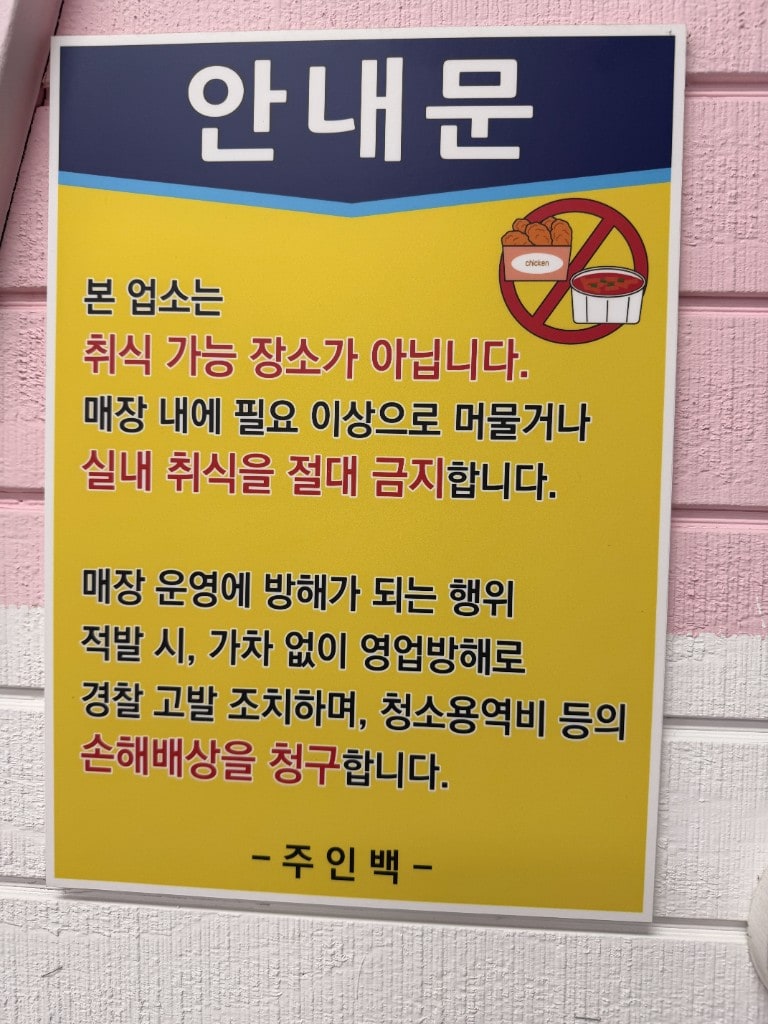
안내문: this is not a place for eating. Do not linger. Break the rules and it's treated as disruption — signed, the owner.
Taped near the entrance is a notice stating that customers may not linger inside past a certain point, and that eating or drinking on the premises is not permitted. In an unmanned shop. A shop whose entire identity is the absence of a person telling you what to do. The sign is, in effect, doing the job a staff member would normally do in any other convenience store — except it can't actually enforce anything, it can only ask (and threaten police reports in very polite Korean).
The logic makes sense once you think about it for longer than ten seconds: no staff means no one to notice, gently, that a couple has turned the freezer aisle into a date spot, or that someone's been standing in the air conditioning for forty-five minutes without buying anything. The owner isn't there to say anything, so the rule has to say it for them, in advance, to everyone, whether it applies to you or not.
But the irony doesn't fully go away just because I understand it. The entire pitch of a 무인 store is "come and go as you please, no one's watching." The fine print says: come, buy, and please leave — quickly, and without eating what you just bought. It's a shop built entirely around the absence of a person that still needs a sign to do a person's job.
You Pay a Kiosk, Not a Person
The other half of the system sits at the back wall: a self-checkout kiosk with a barcode scanner, a coin slot, and buttons for KakaoPay, cash, or card. No greeting. No "did you find everything." You scan, the screen lists your line items, you tap payment, and you leave with a plastic bag or nothing at all.
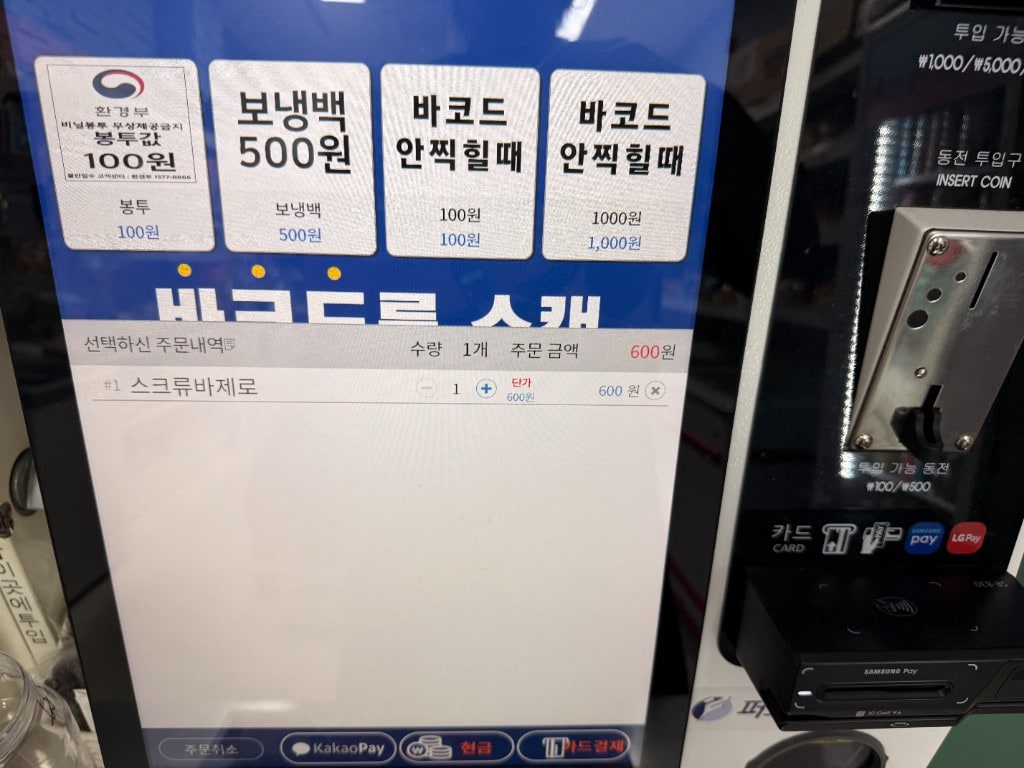
My cart, mid-checkout: 스크류바제로 × 1 — ₩600. KakaoPay, cash, or card. Nobody behind the counter to thank.
The night I finally bought something, that line item was the zero-sugar Screw Bar. Thirty years of twisted pink nostalgia compressed into a ₩600 barcode, paid to a machine under a CCTV camera. That is the whole promise of these shops in one transaction: rising labor costs elsewhere, and here a freezer room that still works because nobody has to be clocked in for your 1 a.m. dessert.
What It Actually Is, Once You Strip the Irony Out
Set the sign aside, though, and what's left is a strangely honest piece of infrastructure. A resident can walk down at 3am in pajamas, buy a protein bar shaped like a popsicle — or a Lalasweet, or a Screw Bar Zero — and be back upstairs in ninety seconds, having interacted with exactly zero other humans. No small talk, no eye contact, no judgment about the third ice cream this week. It's retail with all the friction sanded off — and the freezer just happens to be stocked with a running inventory of whatever Korea's dessert culture is currently anxious, proud, or curious about.
I still don't fully know what to make of a store that never closes and doesn't want you to stay. But I've started treating the freezer like a rolling index of what Korea wants from dessert this year — less sugar, more protein, and the childhood Screw Bar reinvented so it can keep showing up.
Location note: Ordinary apartment complex unmanned ice cream shop in Seoul. Exact building withheld — please be respectful of residents if you go looking for it.