Korea Has Three Government-Approved Days to Eat Chicken Soup — And Everyone Actually Does
Three days a year, the entire country agrees to eat the same soup for reasons rooted in a calendar almost no one under 60 can fully explain — and somehow that's exactly what makes it work.
2026-07-15 · 6 min read
I found out tomorrow is Chobok the way I find out about most things here now: not from a calendar, but from a delivery app banner and a coworker asking, half in passing, if I'd already booked a table somewhere. Nobody sends out a memo. It just arrives, the way weather arrives.
Three Days Nobody Marks on a Calendar
Chobok, Jungbok, Malbok — the Sambok, three days spaced across roughly a month of the hottest stretch of summer, determined by a lunar-calendar system that dates back over a thousand years. This year they land on July 15, July 25, and August 14. Ask most Koreans what sambok actually means astronomically and you'll get a shrug — something about the sun, something about yin and yang, something their grandmother explained once. What nobody shrugs about is what you're supposed to do on these days: eat samgyetang, a whole young chicken stuffed with glutinous rice, ginseng, garlic, and jujube, boiled until the meat gives way from the bone.
No official holiday, no day off — just a date everyone somehow agrees on.
The logic, when people bother to explain it, is iyeolchiyeol (이열치열) — literally "fighting heat with heat." You eat something hot and internally warming during the hottest days of the year, on the theory that your body's response to that internal heat cools you down more than anything cold could. It sounds like the kind of folk wisdom that shouldn't survive contact with air conditioning. It has survived anyway.
Where I Learned Samgyetang Could Be Great
My own relationship with samgyetang started at Tosokchon, near Gyeongbokgung, back when I had my first job out of school. It was the place we took clients, or wherever a work lunch ended up when it needed to feel like an occasion. Tosokchon's broth was unlike any samgyetang I'd had before — thick, almost gelatinous, dark enough that people half-joked they were using snake stock to get it that rich. It was the first time I understood samgyetang could actually be good, not just something you were obligated to eat on the right day.
The building used to be a hanok, so eating there meant sitting in what used to be someone's actual house: a courtyard, a run of small rooms, a low table in each.
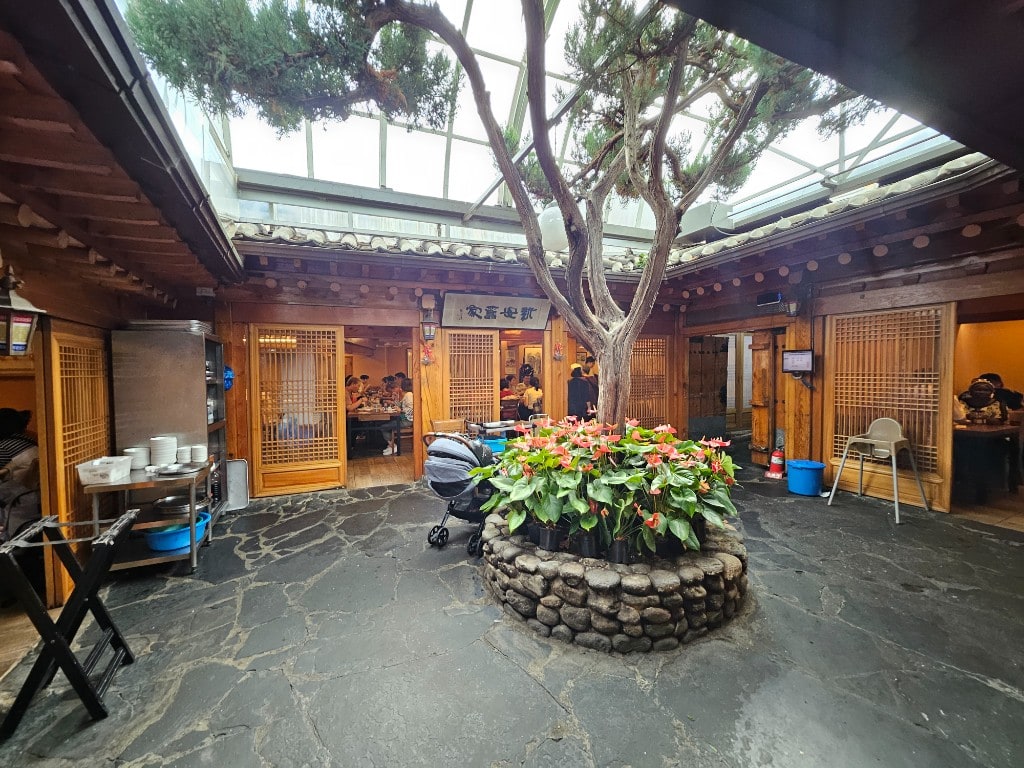
A hanok turned restaurant — courtyard in the middle, a low table behind every sliding door.
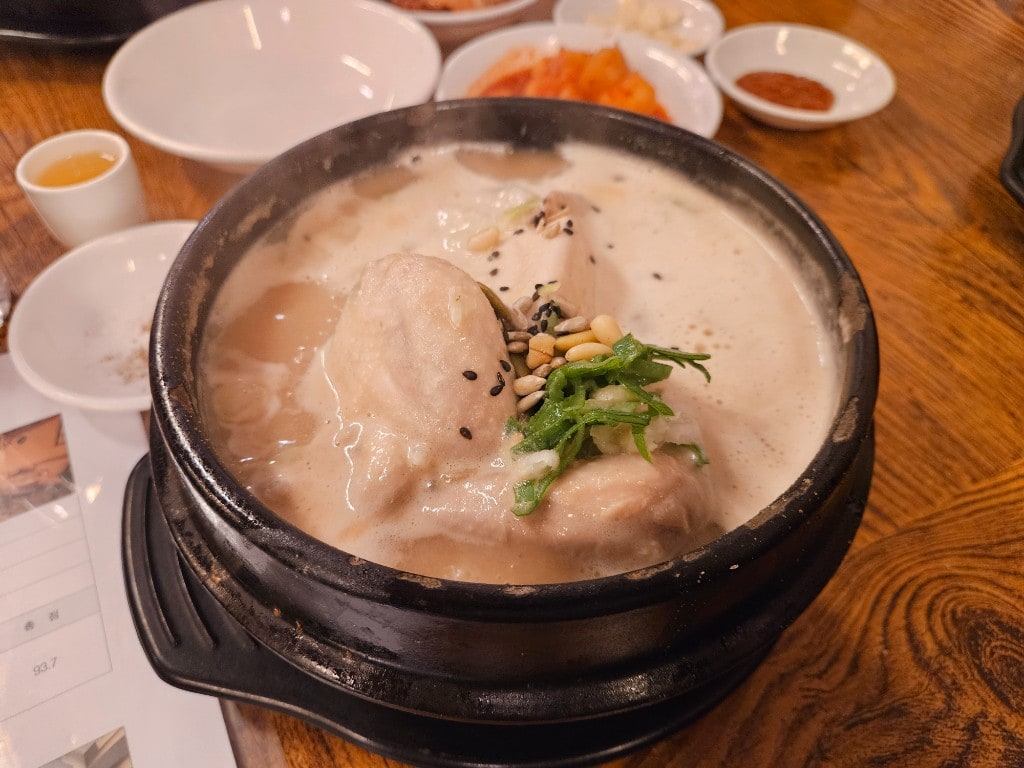
The bowl that taught me samgyetang could actually be great — thick, creamy broth, whole chicken, the usual banchan.
These days Tosokchon does too much business to feel like anyone's house anymore. It's a line-out-the-door, tour-bus-adjacent institution now, foreign visitors as common as regulars. On an actual Bok-nal, I'd guess the wait is close to mandatory.
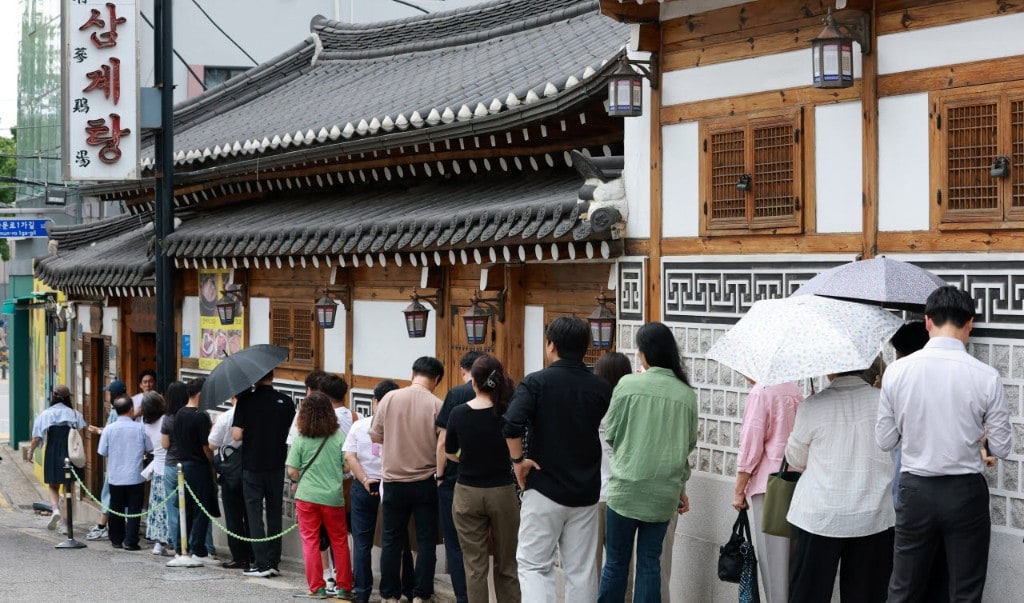
Outside Tosokchon around Bok-nal — the national appointment, visible from the sidewalk. (Source: Nate News)
The Neighborhood Version
My second samgyetang education came later, from a neighborhood chain an oppa I knew — an older guy from the area — opened nearby: Gaeseong Sanghwang Mushroom Samgyetang (개성상황버섯삼계탕). His version leaned medicinal: sanghwang mushroom and a mix of hanyak — dried roots and herbs used in traditional Korean medicine, distinct from Chinese or Japanese herbal traditions — steeped into the broth until the whole bowl smelled faintly like a pharmacy, in the best way. Finishing it felt less like eating lunch and more like doing something responsible for your body.
The glutinous rice came with free refills, which I learned the hard way is a trap — eat as much as they'll give you and you'll feel a blood sugar crash by 3 p.m. What I actually ordered most days was banggyetang, the half-size version, small enough to eat on a lunch break without spending the rest of the day regretting it.
Gaeseong's take: golden sanghwang broth that smells faintly like a pharmacy — in a good way.
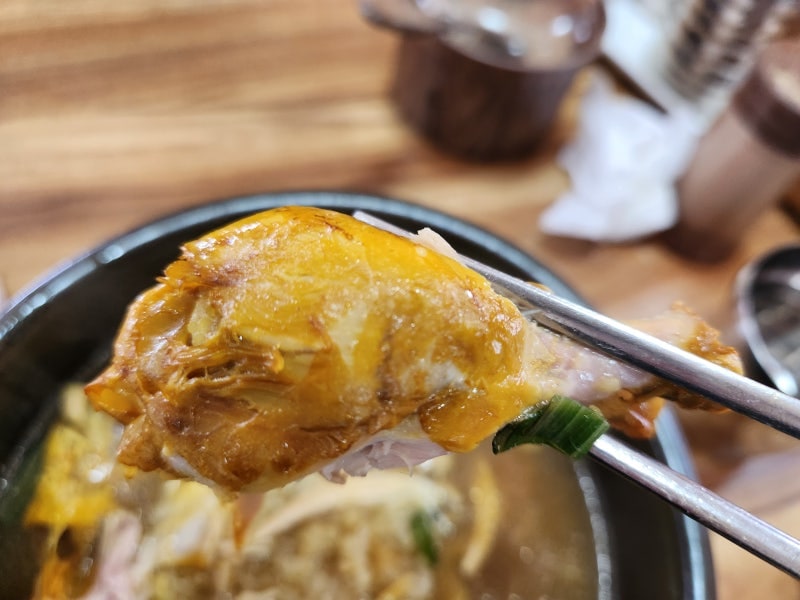
The drumstick gives away the sanghwang color — yellow from the medicinal mushroom broth.
The Option That's Mostly Gone
There used to be a second option on Bok-nal, one that's mostly gone now: boshintang, made with dog meat, which some people believed delivered the same iyeolchiyeol logic even more effectively. In January 2024, the National Assembly passed a special act ending the breeding, slaughter, and sale of dogs for meat, with a full ban taking effect from 2027 — legislation associated with then-President Yoon Suk-yeol and, more visibly, his wife Kim Keon-hee, who had been an outspoken advocate for it. Openly operating boshintang restaurants are essentially gone now. If I'm being honest, it's about the one policy from that administration I have nothing bad to say about. Bok-nal, for almost everyone now, just means samgyetang.
A National Appointment Nobody Booked
What actually got my attention wasn't the food. It was the coordination. Nobody organizes this. There's no Sambok committee. And yet on the right day, every samgyetang restaurant in the neighborhood has a line, every delivery app pushes the same banner, every convenience store stocks the same instant version in the cold case, and everyone over 50 in my life asks, unprompted, whether I've eaten yet. It's a national appointment nobody had to book.
That's the part that doesn't translate from the outside. Framed as content, Sambok reads as a quaint tradition — "ancient Korean superstition about eating hot soup in summer," the kind of caption that turns a thousand-year-old agricultural calendar into a listicle bullet point. Lived from the inside, on a random Wednesday in July, it's closer to a national inside joke that everyone is in on simultaneously. You don't need to believe the yin-and-yang mechanics to feel the pull of everyone around you doing the same thing on the same day for reasons that predate all of you.
And Still, Bok-nal
I don't fully understand the lunar math behind why Chobok falls on July 15 this year and not, say, July 11. I've stopped trying to. What I understand instead is the throughline: from the bowl at Tosokchon that taught me samgyetang could be genuinely great, to the half portions I now order out of habit rather than obligation, I don't think I've missed a Bok-nal since I moved here. I'd guess most Koreans could say the same.
Nobody sends the memo. Everybody still shows up.
Location note: Tosokchon Samgyetang, Jahamun-ro 5-gil, Jongno-gu (near Gyeongbokgung Station) — expect a wait on Bok-nal. Also: Gaeseong Sanghwang Mushroom Samgyetang (개성상황버섯삼계탕), a neighborhood-style chain for the medicinal sanghwang version.